In the red desert of the Very Bad Lands, a Runabout hobbles through the noon heat with a crocked ankle, a clockwork watch she cannot read, and a bullet she is expected to use on herself if captured.
This is the world after the fourth shift.
After AGI, the world didn’t end. It divided. A novel about two societies — one where AI has been so deeply assimilated nobody mentions it, the other where rejecting it has become religion. Between Orwell’s clarity and Welles’s roads not taken. Written in a language all its own.
Most novels about AI imagine the catastrophe — the singularity, the robot uprising, the dystopia of the next ten years. O.Welles 19/8.4 is set further on, in the world after the catastrophe never quite arrived. AI did not end us. It split us.
The novel depicts two societies that emerged on either side of the fourth shift — the great cognitive transition that follows language, writing, and print. One assimilated AI so totally that, like moveable type before it, nobody mentions it any more. The other rejected it so totally that the refusal itself has hardened into doctrine.
Both are recognisable. Both are with us in embryo today. The novel asks the reader to walk between them.
A working society in which AGI is ambient infrastructure — so deeply assimilated that nobody discusses it, in the way nobody now discusses the printing press. Its civic institution is Mootball, a sport in which physical and intellectual contest happen simultaneously. A society that has not eliminated contest. It has civilised it.
A Global Permanent Insurgence which proudly proclaims itself “One True Free.” Brutal, fixed, scarce, sacred. Communicates only via human runners. Burns its messages. Expects its messengers to sacrifice themselves rather than divulge a single secret. The author’s stand-in for everything the print era’s worst political instincts produced — now hardened into a religion of refusal.
A society organises itself around the complete and total suppression of surprise — and calls it freedom.
The opening of the novel — the Runabout’s journey through the Very Bad Lands — read aloud. Free, no signup, fifteen minutes or so. The clearest way to know whether the book is for you is to hear it.
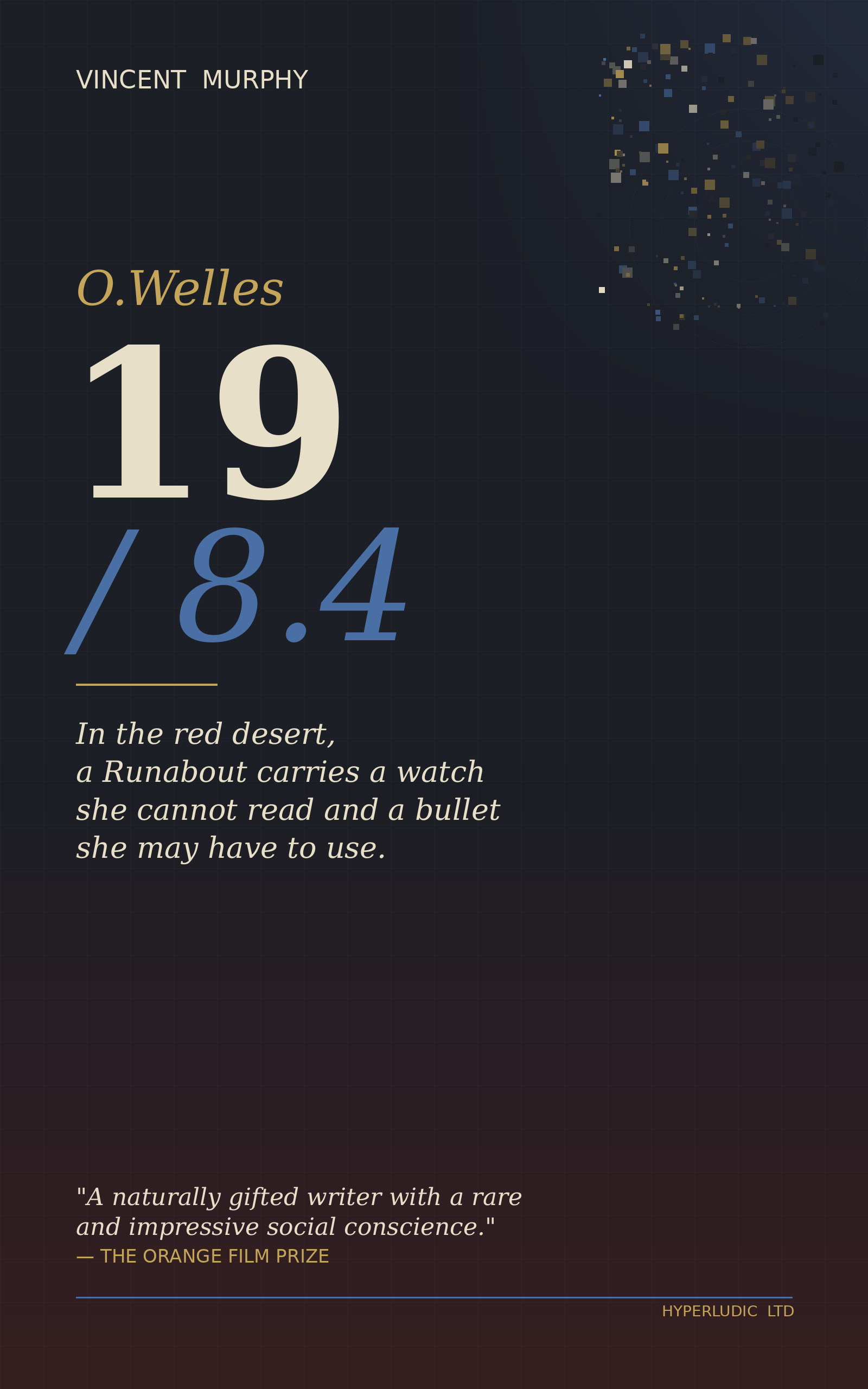
A naturally gifted writer with a rare and impressive social conscience.— The Orange Film Prize
The article that became the novel — Facing the Coming Problem of AI & Robots — was written in January 2017, six months before the publication of “Attention Is All You Need,” the paper that gave the world the transformer architecture. The argument came out of years of monitoring the field and reasoning forward; the novel followed shortly after, an attempt to imagine the society on the other side of the imminent shift.
The book has been held back until now because the audience the world has just spent eight years assembling is, finally, ready to read it.
In the red desert, a Runabout carries a watch she cannot read and a bullet she may have to use. Amy’s journey out of Quastralia and across the Great Barrier of Grief into the Interdependent Stake — and into Mootball, the civic institution of a society that worked.
Amy and Eudi together — adventuring back into the territories beyond the Barrier. The book opens at Bewilderment Camp, twelve weeks of intensive return to ancestral conditions, and follows their entry into Quas via The Top End.
The third movement of the arc. Outline complete; drafting to follow Book Two. The title is a triple pun, deliberate, and entirely appropriate to a series whose central conceit is that the words we have inherited may not be quite the right ones for what comes next.
For agents, editors, and rights enquiries on the trilogy as a whole, see below.
Most speculative fiction goes negative because conflict is easier to dramatise than its absence. Imagining a society that worked — and finding the conflict, drama, and stakes within it — has been attempted only rarely:
The Culture novels. Post-scarcity society as ongoing dramatic substrate.
Anarres in The Dispossessed. The working anarchist society and its real costs.
The functional-but-strange. Society that works, but on its own unsettling terms.
1984’s coordinates and structure, but flipped. The appendix-as-thesis device explicitly borrowed from Principles of Newspeak.
The title’s substitution — Welles for Orwell — is the first of the novel’s moves. Orson Welles appears in the book as a character; the Snooper projectile that the Humilitary fire across the Great Barrier carries the designation 19/8.4. The reader, in other words, is being snooped.
Book One is now live on Kindle. Chapter One is being serialised on YouTube in the author’s voice. Book Two due December 2026; Book Three outlined. Review copies, manuscript excerpts, trilogy synopses, and interview availability on request.
For broader context on the author’s frameworks (Cognology, Ludicity, the Printocene, the Three S Shift) and how they relate to the novel’s world-building, see the Lexicon.
vincent@vincentmurphy.co.uk