Where the Woah framework addresses the philosophical and civilisational dimensions of exponential change, The Little Book of Woah is the practical companion — the guide for anyone who has felt the vertigo of rapid AI change and wants a way through it that is neither denial nor despair.
It draws on Zen wisdom, Shannon's Information Theory, and exponential thinking to offer four principles for navigating the AI age with clarity and equanimity. Free to download, free to share, designed to be passed on.
Understanding the deeper shifts. Knowing which signal to heed.
Change carries seeds of possibility. Indra's Net connects all.
Cultivate beginner's mind. Trust in experimentation. Pivot.
Human values and technology shaping each other, mutually.
May you greet each new shift with a resounding: "Woah!"
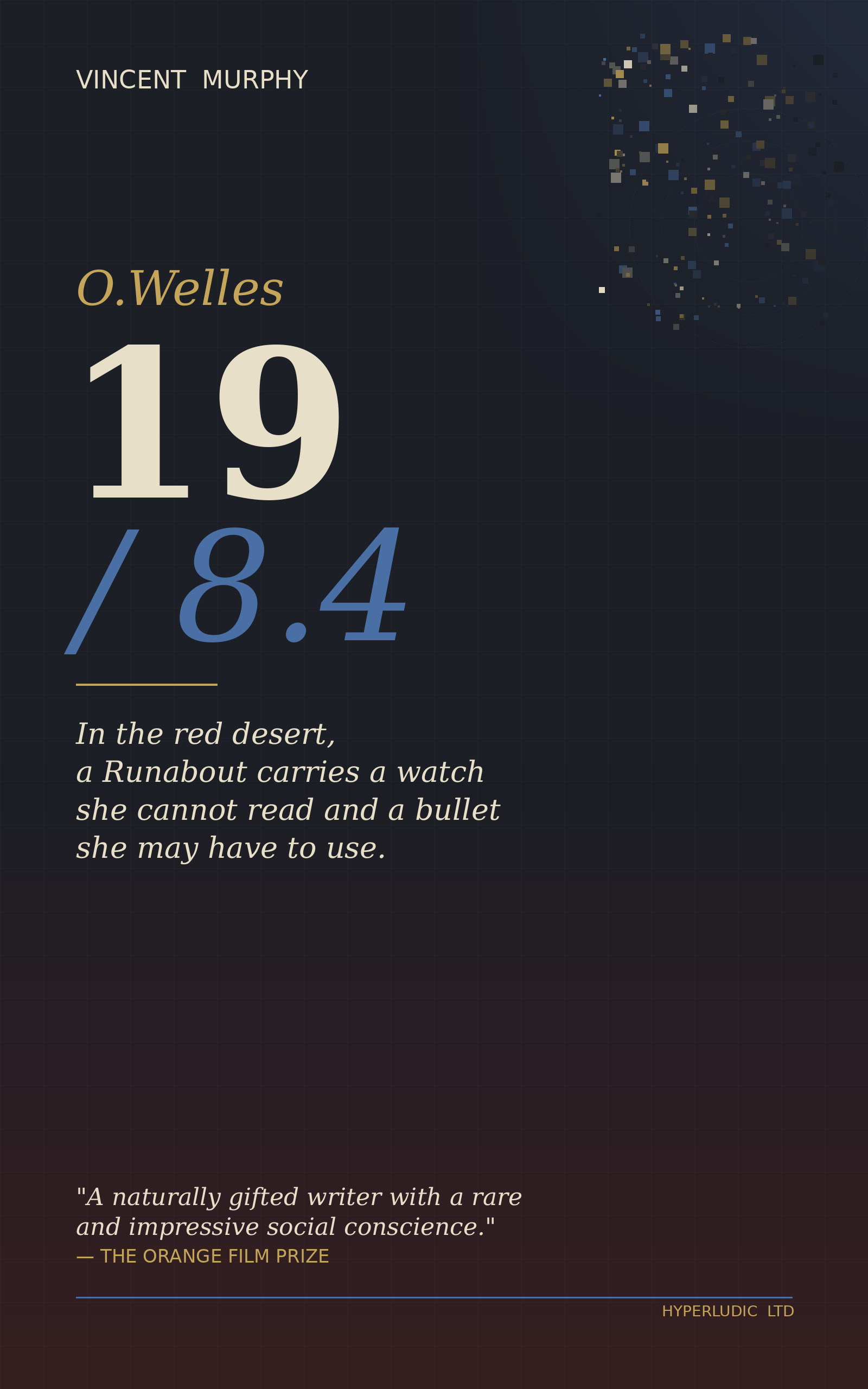
In the red desert of the Very Bad Lands, a Runabout hobbles through the noon heat with a crocked ankle, a clockwork watch she cannot read, and a bullet she is expected to use on herself if captured.
This is the world after the fourth shift. Not the dystopia of robots and singularities — something stranger and more recognisable: a society that has organised itself around the suppression of surprise and called it freedom. Between Orwell's clarity and Welles's roads not taken. Written in a language all its own.
"A naturally gifted writer with a rare and impressive social conscience."
— The Orange Film Prize
Once published on Amazon, replace ASIN_PLACEHOLDER in the two links above with your book's ASIN to activate the buy buttons.
The official governing document of the world's most consequential sport — as practised in the world of the novel. A sport and a civic act simultaneously. Neither purpose may be sacrificed without invalidating the contest. Attributed to President O. Welles: "The gladiators died because the crowd was bored. Our players win or lose because the crowd is paying attention. I'll take that trade."
All of them investigate our relationship with evolving technology and its human consequences. Runner-up in the Orange Film Prize — described as coming from "a naturally gifted writer with a rare and impressive social conscience."
Developed with award-winning director Konrad Begg. A deeply troubled former military drone pilot seeking redemption. The film that asks what happens to the human being inside the machine — when the machine is a weapon and the human is trying to find a way back.
A young care-worker is driven to desperate lengths to publicise the plight of the people she works with. The Orange Film Prize declared it as coming from "a naturally gifted writer with a rare and impressive social conscience." The social conscience that runs through the entire body of work, in screenplay form.
Played out over just 48 hours, we witness a young, jaded New Yorker going from broke and despairing to becoming one of the richest, most powerful people in all of human history. Written from direct experience of New York — the Waldorf, Ketchum, the Institute of Private Investors. The comedy of extreme wealth observed from close quarters.
A terminally ill money launderer faces the wrath of his former clients as he seeks ever more novel ways to give away their ill-gotten gains. Moral inversion as plot engine — the criminal as the most ethical person in the room. The social conscience again, this time wearing a crime thriller's coat.
A suite of custom GPTs built using Exponential Thinking — demonstrating that AI tools can be directed toward depth, culture, and insight as readily as toward productivity. Each one is a small demonstration of Ludicity: AI shaped by human intent, constrained by purpose, verified by use.
A sixteen-question diagnostic tool assessing organisational readiness for AI-driven disruption across four dimensions. Built for leadership teams who want to understand their actual position — not the position they assume they're in.
Don't wait for disruption to happen. Understanding your vulnerabilities is the first step towards leveraging AI for both resilience and growth.
How dependent your organisation is on traditional structures for approvals and decisions.
How effectively information flows and how transparent communication is across departments.
The flexibility of your organisation's response to novelty and change.
The extent to which core work relies on older formats and methods. The Printocene question, made measurable.
Scores reveal LOW, MEDIUM, or HIGH disruption vulnerability — with specific recommendations for each dimension. Available as a workshop facilitated by Vincent or as a standalone assessment.